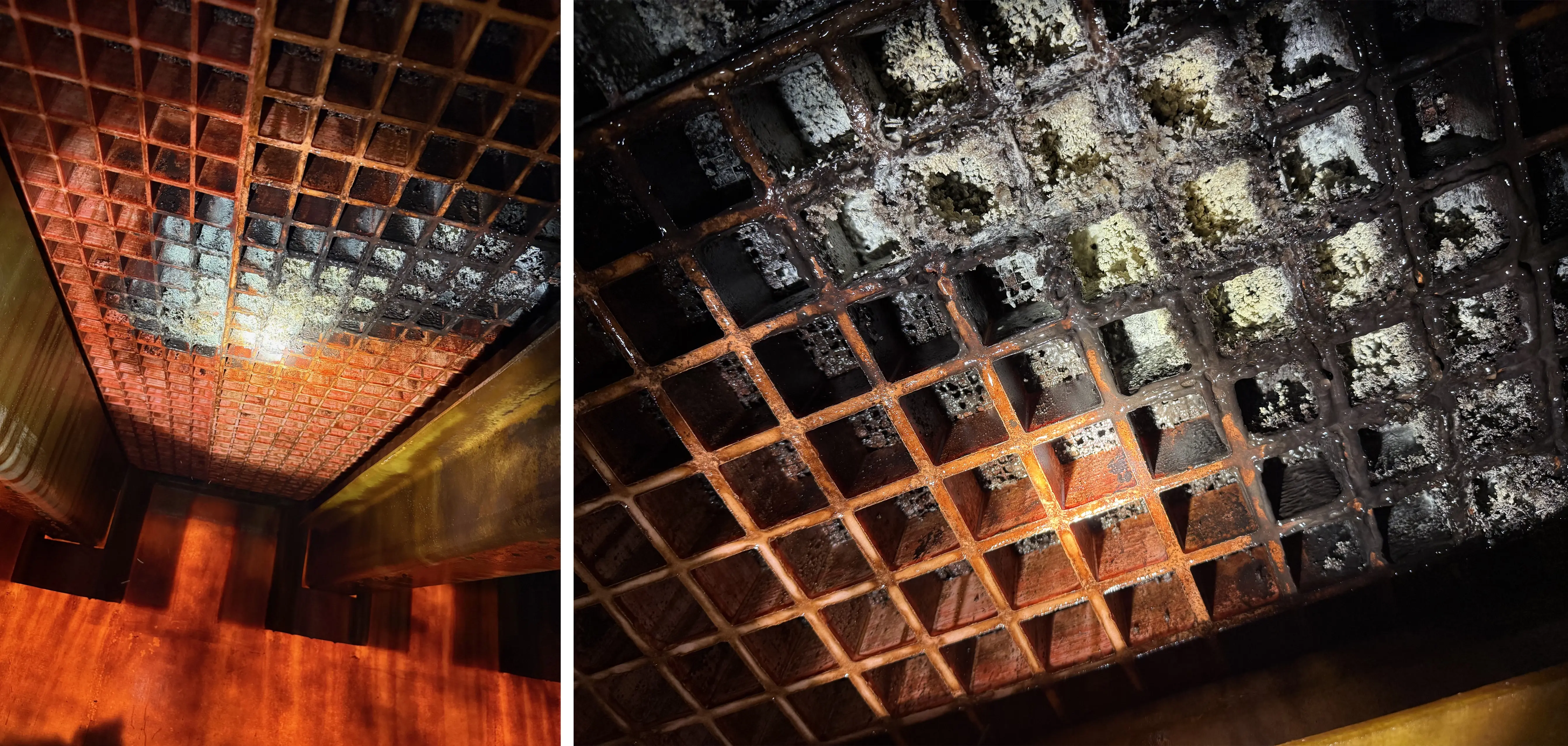
Localized biological and chemical byproduct buildup observed on underside of support grate.
A municipal bioscrubber system began experiencing clogged spray nozzles and the presence of media in the recirculation system after 10 years of operation. An engineering evaluation revealed localized accumulation and media migration in the system.
This white paper identifies probable causes, assesses system behavior, and provides practical recommendations for cleaning and prevention.
Field Observation
- White/gray accumulation localized in specific areas
- Non-uniform distribution
- Spray nozzle clogging with reddish particulate
- Media presence in recirculation system
The support grate acted as a transition zone where airflow velocity changes and moisture accumulates, creating ideal conditions for deposition. Localized buildup indicated imbalance in airflow or irrigation, leading to preferential accumulation zones.
The accumulation was consistent with biological and chemical byproducts rather than media degradation.
- Biological Sloughing: Detached biofilm from sulfur-oxidizing bacteria
- Elemental Sulfur: Byproduct of H2S oxidation at low pH conditions
- Sulfate Residues: Precipitation and crystallization at restriction points
- Environmental Solids: Dust and fine particulates entering the system
Root Cause of Media Migration
The presence of media in the recirculation system suggested a transient breakthrough event.
- Accumulation restricts grate openings
- Localized loading increases
- Surge event occurs
- Temporary pathway forms
- Media migrates through system
Crater-Max® and Cell-Max™ media are structurally stable and resistant to acidic conditions. There was no evidence that these materials degraded into fines under normal operating conditions. Observed solids were process-generated, not media-derived.
Cleaning Recommendations
- Use low-pressure water (200 – 500 psi)
- Maintain 12 – 18 inches distance
- Use fan spray nozzle
- Perform pulsed cleaning
- Protect recirculation pumps during cleaning
Preventative Measures
- Maintain spray nozzle performance
- Verify uniform irrigation coverage
- Conduct airflow distribution checks
- Perform periodic inspection of grate and sump
Engineering Conclusion and Professional Opinion
Based on review of the field observations, operating history, and known biological and chemical mechanisms within bioscrubber systems, it is our professional engineering opinion that the localized accumulation observed on the support grate was the result of normal biological sloughing and sulfur compound deposition associated with long-term operation under acidic, sulfur-oxidizing conditions. The characteristics of the material — its color, texture, and localized distribution — were consistent with biofilm detachment and elemental sulfur formation, not structural or material degradation.
Furthermore, the presence of media within the recirculation system was most appropriately attributed to a transient, localized breakthrough event, likely caused by temporary restriction at the support interface combined with a hydraulic or airflow surge condition. This type of event can occur without leaving a persistent or visually obvious structural opening in the support system.
There was no evidence to indicate that the installed Crater-Max® or Cell-Max™ media had undergone physical degradation, chemical breakdown, or loss of structural integrity. Both materials were engineered and widely demonstrated to maintain stability under low pH and high H2S loading environments typical of bioscrubber operation.
The condition described herein was, therefore, assessed to be operational in nature rather than material-related. This event was consistent with expected long-term system behavior where distribution imbalances, solids accumulation, and periodic sloughing events can occur.
With implementation of the recommended corrective actions, specifically:
- Controlled in-place cleaning of the support grate
- Verification and maintenance of uniform irrigation distribution
- Confirmation of balanced airflow conditions
The system is expected to return to stable operation without the need for media replacement or structural modification.
From an engineering standpoint, the observed condition does not constitute a failure of the media or support system, but rather a manageable maintenance condition inherent to biological treatment processes.