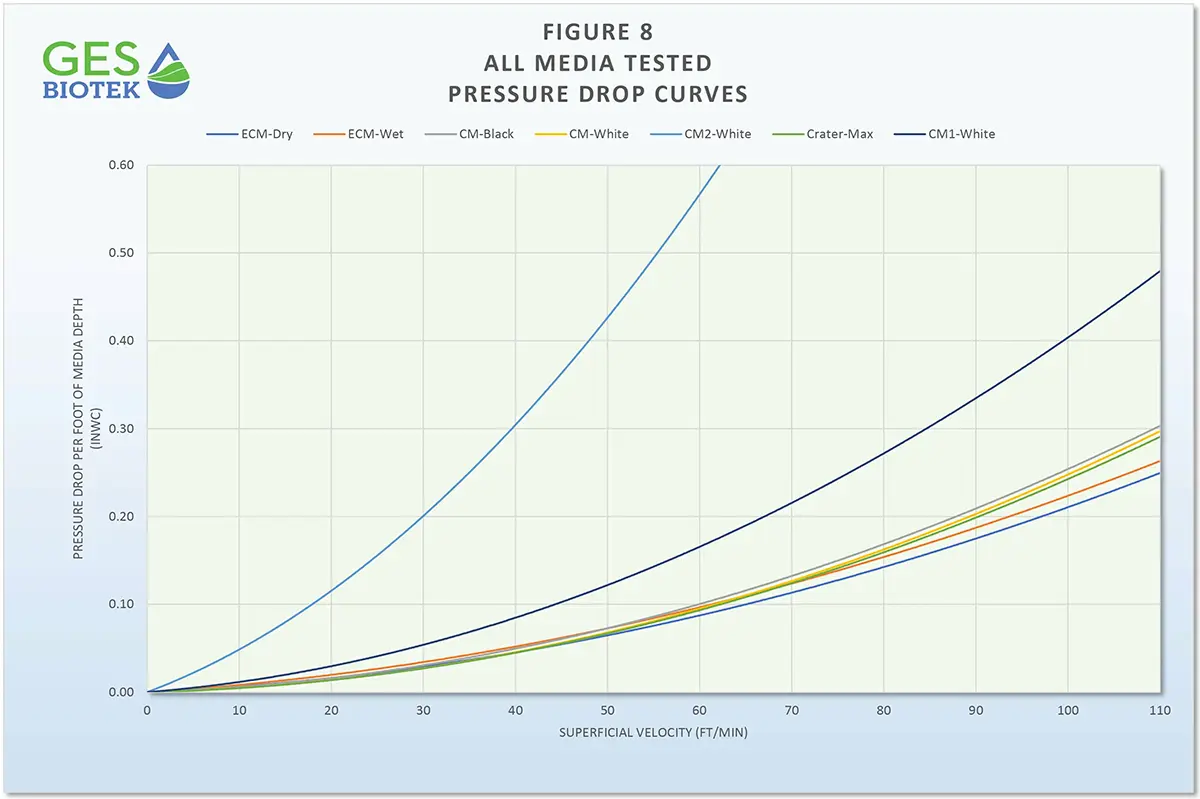
GES Biotek media maintain low pressure drop while providing uniform gas distribution.
Pressure drop curves are one of the most important engineering tools used to evaluate the hydraulic and aerodynamic performance of a biofilter system. These curves define the relationship between superficial airflow velocity or airflow rate (CFM) and the resulting static pressure loss (inches water column) across the media bed.
The pressure drop characteristics of a media directly influence:
- Fan selection
- Energy consumption
- Airflow distribution
- Treatment efficiency
- Long-term operating costs
Expected Resistance
During biofilter or bioscrubber design, pressure drop curves are used to establish the expected resistance of the media at various airflow rates. The selected fan must overcome the combined resistance of the media, support floor, underdrain system, ductwork, misting system, and any additional process components while maintaining the required design airflow. For this reason, accurate pressure drop data is crucial for proper fan sizing and lifecycle cost analysis.
Causes of Pressure Loss
In clean-bed conditions, pressure loss through the media is primarily governed by the media’s physical characteristics, including:
- Void fraction (porosity)
- Effective pore diameter
- Particle geometry
- Surface roughness
- Media depth
- Air velocity through the bed
As airflow increases, frictional losses increase, producing the characteristic upward-sloping pressure drop curve. The shape and slope of the curve provide insight into the media’s permeability and airflow resistance characteristics.
Media Porosity
For biological odor control applications, media porosity plays a critical role in maintaining low operating pressure losses while simultaneously providing sufficient surface area for microbial colonization. Media with inadequate pore volume may initially provide acceptable treatment performance but often experiences rapid increases in pressure drop as biomass develops within the pore structure.
Biomass Accumulation
Over time, all biological treatment systems experience some degree of biomass accumulation as sulfur-oxidizing bacteria, heterotrophic bacteria, fungi, and other microorganisms colonize the media surface. This biological growth narrows airflow pathways and increases resistance. In addition, airborne particulate matter and reaction byproducts can accumulate within the bed, further contributing to pressure loss.
Decomposition
For traditional organic media systems such as wood chips, compost, bark, and mulch-based mixtures, additional mechanisms contribute to pressure drop increases:
- Biological decomposition of the media matrix
- Settling and consolidation under self-weight
- Particle breakdown and fines generation
- Moisture-induced compaction
- Channel plugging from decomposed organic material
These mechanisms reduce effective pore space and increase tortuosity of airflow pathways. As a result, the pressure drop curve shifts upward over time, requiring greater fan horsepower to maintain the same airflow. In many cases, fan energy consumption can increase significantly during the operational life of the media, and airflow distribution may become non-uniform, creating dead zones and reducing treatment efficiency.
Fan Power Requirements
From an engineering perspective, fan power requirements are directly related to system pressure loss. Fan brake horsepower can be estimated using:
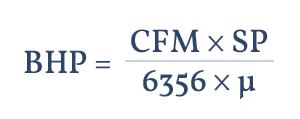
where:
- BHP = Brake Horsepower
- CFM = Airflow Rate
- SP = Static Pressure (in w.c.)
- μ = Fan Efficiency
As pressure drop increases, fan horsepower and electrical energy consumption increase proportionally. Consequently, media that maintains a stable pressure drop profile throughout its service life provides significant operational cost advantages.
Pressure Drop Monitoring
Pressure drop monitoring serves as a valuable diagnostic tool for operating facilities. A gradual increase in pressure loss typically indicates normal biomass development, while sudden increases may suggest:
- Excessive biomass accumulation
- Over-irrigation
- Media plugging
- Distribution system issues
- Drainage restrictions
- Particulate loading from upstream processes
By periodically comparing field measurements against baseline clean-bed pressure drop curves, operators can identify performance issues before significant treatment losses occur.
GES Biotek Media
GES Biotek’s Cell-Max™ Plus and Enhanced Cell-Max™ Plus engineered media are specifically designed to address long-term performance challenges. Manufactured from recycled glass and proprietary mineral formulations, both media products provide a rigid, inorganic structure that resists:
- Biological decomposition
- Physical compaction
- Acid degradation
- Moisture-induced collapse
- Particle breakdown
Unlike organic media, Cell-Max™ Plus and Enhanced Cell-Max™ Plus maintain their original structural geometry throughout operation, preserving pore volume and airflow pathways even under high moisture and low-pH conditions commonly encountered in hydrogen sulfide treatment applications.
The result is a pressure drop profile that remains substantially more stable over time, reducing:
- Fan energy consumption
- Maintenance frequency
- Airflow balancing requirements
- Risk of media replacement due to compaction
- Overall lifecycle operating costs
For municipal wastewater odor control systems designed for service lives exceeding 20 years, maintaining low and predictable pressure loss is often as important as achieving high contaminant removal efficiency. Consequently, pressure drop performance should be evaluated not only on a clean-bed basis but also on the media’s ability to maintain hydraulic and aerodynamic stability throughout its operational life.
View the pressure drop curves for Cell-Max™ Plus and Enhanced Cell-Max™ Plus media as well as GES Biotek’s other biofilter media by clicking the button below.